 Contact
Why we usually advise against an EU Joint Scientific Consultation for medical device and diagnostic companies
Understanding the relevant PICO across European markets, and the study design needed to satisfy it, matters more than ever. Yet we rarely recommend that a company apply for an EU Joint Scientific Consultation (JSC). Here is the thinking behind that.
26 September 2026
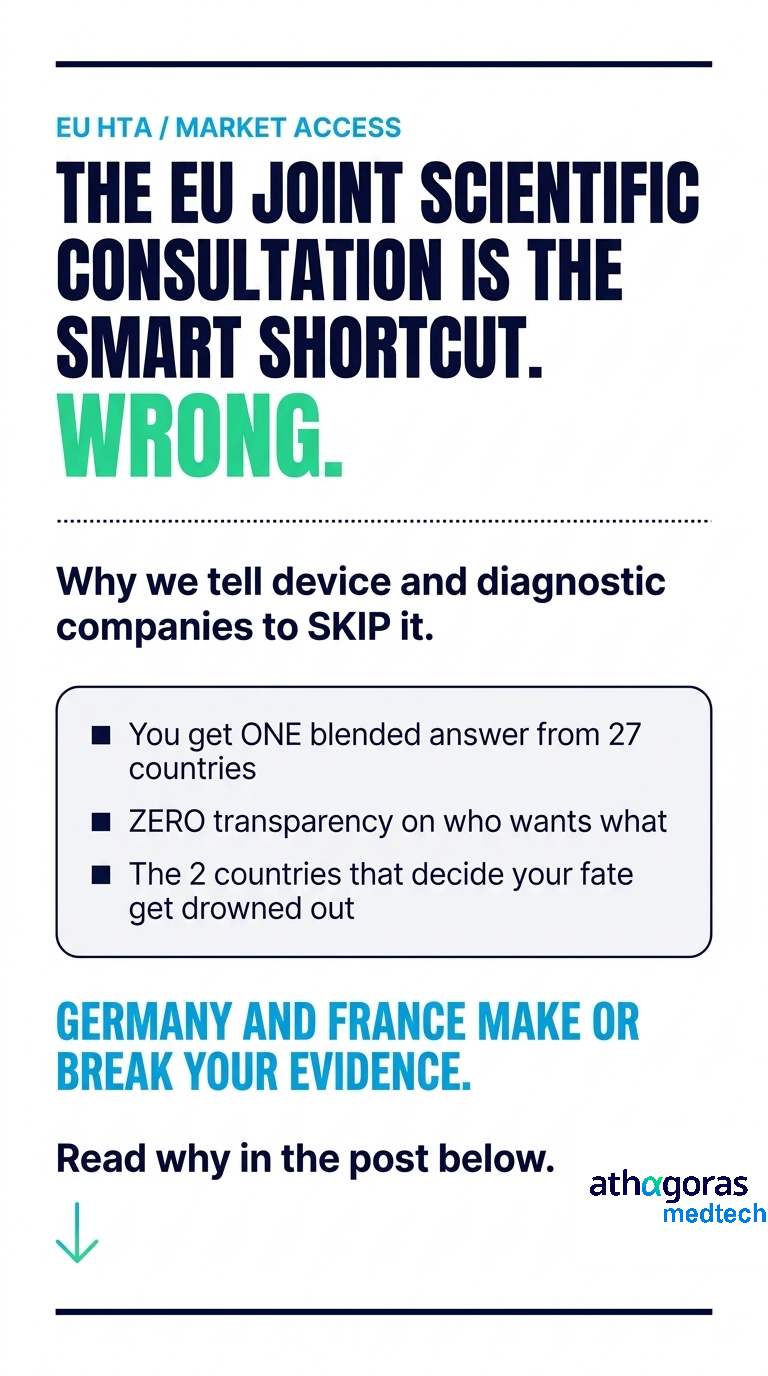
Understanding the relevant PICO across European markets, and the study design needed to satisfy it, matters more than ever. Yet we rarely recommend that a company apply for an EU Joint Scientific Consultation (JSC). Here is the thinking behind that:
The feedback is consolidated, and country-blind by design. Under the HTA Regulation, the assessment scope "shall be inclusive and reflect Member States' needs." In practice, national PICOs are collected through a survey and then merged by the assessor into the smallest possible set of consolidated PICOs before they reach the developer. The output you receive is an aggregate: it tells you which populations, comparators and outcomes must be addressed, but not which country is behind which requirement. In the Coordination Group's own worked example, five Member States produce seven separate PICOs for a single indication. That fragmentation is the norm, not the exception, and it is exactly the signal you lose when advice arrives pre-blended.
Why does country attribution matter so much? Because the requirements are not equally demanding, and you cannot design an efficient study against an averaged target.
Two countries decide whether your evidence will actually hold up.
Germany's G-BA is strict on comparing the right population against the right comparator, and, more importantly, requires the study to demonstrate an improvement in patient-relevant outcomes. Miss this, and the clinical benefit can be judged as not proven regardless of the rest of the dossier.
In France, the study has to be built to maximise the added clinical benefit (ASA logic), because that rating is what drives the achievable price.
In most other markets the conversation is primarily about cost-effectiveness and far less about specific outcome requirements. So the two design constraints that make or break both reimbursement and price sit in Germany and France, and a consolidated JSC dilutes precisely those two voices into the crowd.
The JSC also carries structural limitations worth naming. The advice is non-binding, and the Coordination Group itself acknowledges that JSC recommendations may no longer apply by the time of assessment because the comparator landscape has moved on. Access is not guaranteed either: eligibility is limited to Class III implantables, certain Class IIb active devices and Class D IVDs, studies must still be in the planning stage, and where eligible requests exceed the planned slots, technologies are selected competitively against criteria such as unmet need and first-in-class. You can invest in the process and still not be chosen, or receive advice that has aged by the time it counts.
What we recommend instead. Every client facing HTA evaluation should first understand the evidence requirements of their actual target countries in depth. Most often that means a national scientific consultation in Germany and France, where you get direct, attributable, market-specific feedback on the population, comparator and outcomes that will determine both approval of the clinical benefit and the price.
There are scenarios where a JSC is the right move, but they are rare.
What's your view on this?
Tags
